



Posted on November 20, 2025 by Keeen
We Have a Handwashing Sink. So Why Is Cross-Contamination Still Happening?
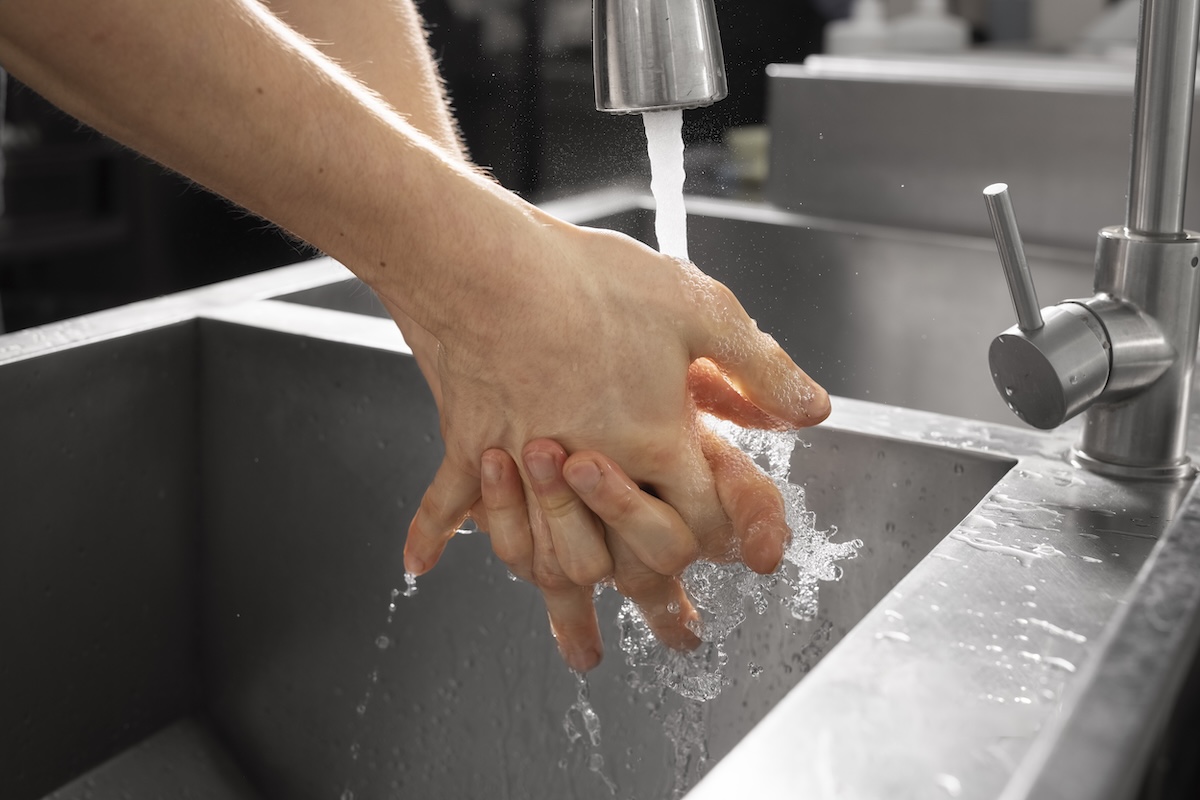
Hands: The Fastest Route for Contamination
In a central kitchen, food processing facility, or commercial restaurant, an employee’s hands touch hundreds of surfaces every hour of work — raw ingredients, utensils, countertops, door handles, and finished food ready for service.
Food safety research consistently identifies hands as the primary vehicle for transferring pathogens such as Salmonella, E. coli, and Norovirus between surfaces in the kitchen. Hand movement is constant, and the contamination it causes is largely invisible and unintentional.
A critical fact: FDA research has found that improper handwashing is the underlying cause in over 40% of investigated foodborne illness outbreaks in the food industry.
“Having a Sink” vs. “Actually Washing Hands” — The Gap That Matters
This is the gap every kitchen faces but rarely discusses openly. Complying with the requirement to have a handwashing sink and having employees actually wash their hands at every critical point are two entirely different things.
Three practical factors determine whether employees wash their hands during real working conditions:
- Distance — If the handwashing sink is more than 3–5 meters from the workstation, handwashing rates drop significantly. Behavioral hygiene research shows that in fast-paced conditions, employees unconsciously eliminate steps they perceive as inconvenient.
- Friction — A tap that requires hand contact to operate, soap that is hard to find, or empty paper towel dispensers are small barriers that in practice cause employees to skip handwashing entirely.
- Workflow placement — If the handwashing station is not positioned within the natural movement path of employees, handwashing will not happen — because it requires a deliberate detour from the normal work route.
Critical Points That Must Have a Handwashing Station Within Reach
GMP, HACCP standards, and food safety regulations define mandatory handwashing points that align directly with operational risk points:
🚪 Kitchen / Production Area Entry
Before employees touch anything, the handwashing station must be the “first checkpoint” that everyone passes through when entering the area.
🥩 Raw Ingredient Preparation Area
Especially raw meat, eggs, and unwashed produce — this area carries the highest contamination risk and requires the most frequent handwashing.
🔄 Task Transition Points
When employees move from raw to cooked zones, or from general work to handling ready-to-eat food, every task transition is a risk point that requires a handwashing station within walking distance.
🗑️ After Contact with Non-Food Surfaces
Waste bins, door handles, smartphones, stair rails, or any equipment that has not been cleaned all carry pathogens that can be transferred to food through hands instantly.
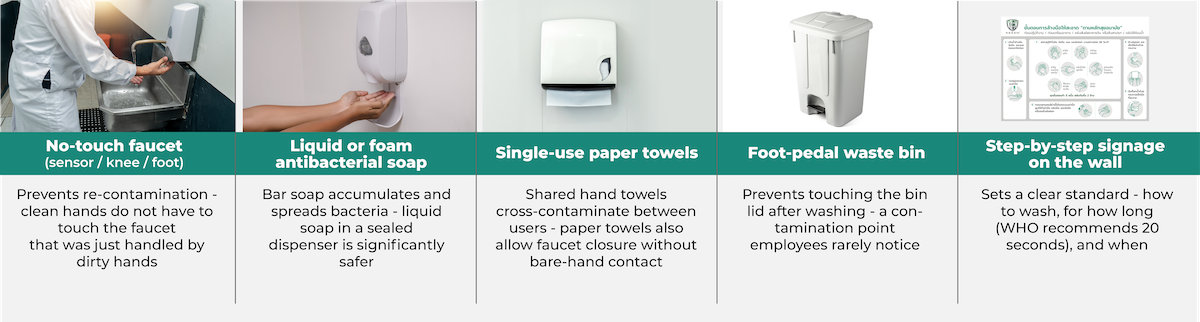
What an Effective Handwashing Station Actually Requires
Effective installation is not just “a sink and water.” It is a system designed so that every step of proper handwashing can occur without friction:
easurable Operational Impact
When handwashing stations are correctly positioned and fully equipped, the practical results in a real kitchen are:
- Reduced cross-contamination — pathogen transfer between surfaces drops significantly, addressing the primary cause of food safety incidents
- Automatic compliance improvement — when handwashing is convenient and integrated into the natural work route, employees do it without needing repeated reminders
- Lower inspection risk — GMP, HACCP, and health authority requirements specify handwashing station placement and quantity as minimum conditions for passing audits
- A culture of hygiene — well-designed, functional stations communicate to employees that the organization is serious about hygiene standards
Design the Correct Behavior to Be the Easiest Behavior
Installing handwashing equipment correctly is not about ticking a compliance box. It is an investment in a system that makes proper hygiene behavior happen every day, on every shift, without relying on enforcement or repeated reminders.
Because ultimately, food safety is not a policy — it is behavior that occurs at the workstation. And that behavior can be designed.